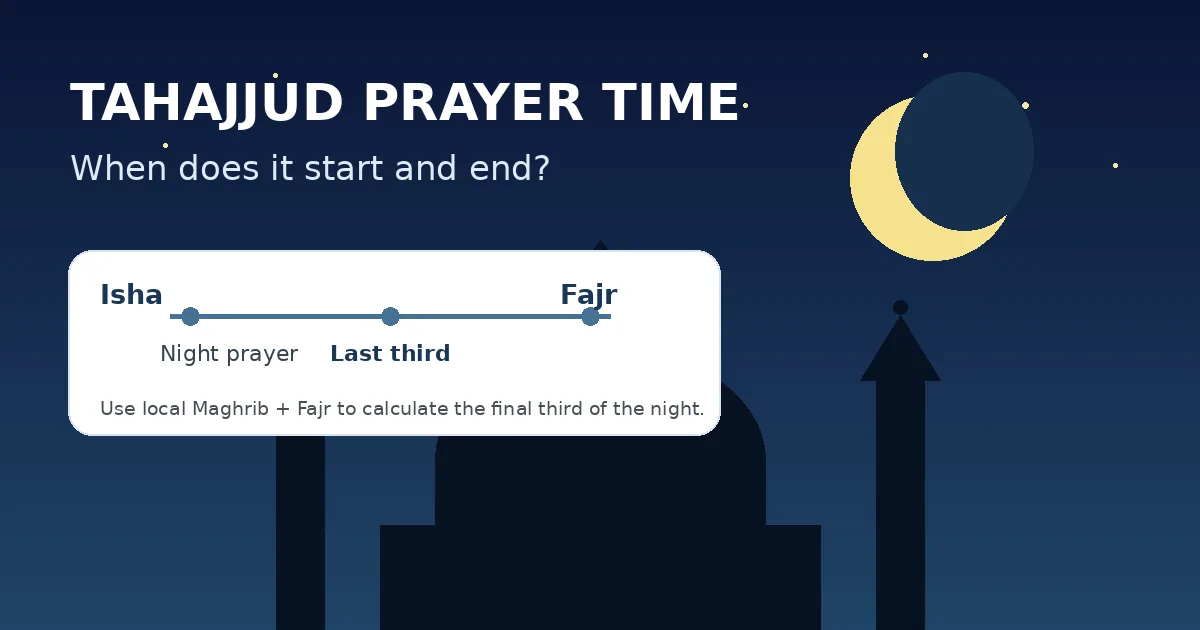
What time is Tahajjud tonight? It sounds like a question that should have one fixed clock answer, but Tahajjud moves with the night. A useful daily answer depends on your local Isha, Maghrib, and Fajr times, which change with location and season.
For everyday planning, Tahajjud prayer time is generally understood as a voluntary night-prayer period after Isha and before Fajr, with special emphasis on the last third of the night. The Qur’an refers to additional worship during the night in Surah Al-Isra 17:79, and a well-known hadith in Sahih al-Bukhari highlights the final third as a time of supplication and seeking forgiveness.
That means a reliable local prayer timetable gives you the raw times you need. The rest is a simple calculation.
What Is Tahajjud Prayer?
Tahajjud is a voluntary night prayer. In common usage, people often use “Tahajjud” and “Qiyam al-Layl” almost interchangeably, but scholars may distinguish the terms more precisely. Some describe qiyam al-layl as voluntary worship at night generally and reserve Tahajjud for prayer after sleeping and waking.
For someone trying to understand the clock, the most important point is simpler: night worship belongs to the period after the obligatory evening prayer and before the arrival of Fajr. If you want a ruling tailored to your school of jurisprudence or personal situation, follow a qualified scholar or your local mosque.
When Does Tahajjud Start?
A practical Tahajjud window begins after Isha has been prayed. Islamic Relief UK, for example, describes Tahajjud as a voluntary prayer performed after Isha and before Fajr, while noting that the final third of the night is especially virtuous.
This is why searching for “Tahajjud at 2:00 AM” can be misleading. At one time of year, 2:00 AM may fall in the last third. In another season or city, it may be in the middle third—or very close to Fajr.
When Does Tahajjud End?
Tahajjud ends when Fajr begins. A hadith about night prayer describes praying during the night and completing Witr before the approach of dawn. The practical lesson is to use the local Fajr start time as the boundary rather than sunrise.
Fajr and sunrise are not interchangeable. Fajr begins at true dawn; sunrise comes later and marks the end of the Fajr prayer window. If you need a refresher on why these daily times move, see Why Do Prayer Times Change Every Day?.
What Is the Last Third of the Night?
The last third of the night is the final one-third of the nighttime period before Fajr. Sahih al-Bukhari records a narration from Abu Huraira describing the last third as a special time for invocation, asking, and seeking forgiveness.
To turn that concept into a clock time, many scholars calculate the night from Maghrib (sunset) to Fajr (true dawn), divide the duration into three equal parts, and identify the final segment. This is more reliable than assuming the last third always begins at midnight or 2:00 AM.
How to Calculate the Last Third of the Night
Find today’s Maghrib time and tomorrow’s Fajr time for your exact location.
Calculate the total amount of time between Maghrib and Fajr, remembering that the interval crosses midnight.
Divide that night length by three.
Subtract one-third from the Fajr time. The result is the approximate start of the last third of the night.
Example: If Maghrib is 6:30 PM and Fajr is 5:30 AM, the night lasts 11 hours. One-third is 3 hours 40 minutes. Counting back 3 hours 40 minutes from Fajr means the final third begins at approximately 1:50 AM.
This example is only a method demonstration. Your actual result should be calculated from today’s prayer times for your location.
Why “Islamic Midnight” and the Last Third Are Not the Same Thing
A common source of confusion is the word “midnight.” The midpoint of the religious night is not automatically 12:00 AM on a civil clock. If the period from Maghrib to Fajr lasts ten hours, its midpoint is five hours after Maghrib. The last third starts later than that midpoint.
This matters because a clock is a human timekeeping system, while prayer schedules are tied to solar events. The same principle explains why Fajr, Maghrib, and Isha move through the year.
Why Tahajjud Time Changes Through the Year
Winter nights are often longer in many regions, so the last third can begin earlier by the clock. Summer nights may be shorter, pushing the last-third window later and sometimes making Isha and Fajr feel unusually close together at higher latitudes.
Daylight-saving changes can also make the displayed clock times jump by about an hour even though the solar sequence continues normally. Prayer Time Tables explains that distinction in Daylight Saving Time and Prayer Times.
Tahajjud, Qiyam al-Layl, and Witr: A Simple Timing View
Qiyam al-Layl: a broad term for voluntary worship during the night; usage and technical definitions can vary.
Tahajjud: commonly used for voluntary night prayer, often especially after sleeping and waking.
Witr: an odd-numbered night prayer that is often made the final prayer of the night; a hadith in Sahih al-Bukhari instructs worshippers who fear the approach of dawn to complete Witr.
These distinctions are useful, but a timetable’s role is narrower: it tells you when Isha and Fajr occur locally so you can plan worship within the correct nighttime window.
How to Use Prayer Time Tables for Tahajjud Tonight
1. Open Prayer Time Tables and confirm that the displayed location is correct.
2. Note today’s Maghrib time, tonight’s Isha time, and the next Fajr time.
3. Use Maghrib-to-Fajr to calculate the night thirds.
4. Choose a realistic wake-up time within the final third, while leaving enough margin before Fajr.
5. If your local mosque follows a specific calculation method, keep your timetable settings consistent with that community when possible.
If Fajr or Isha differs noticeably between two apps, the reason may be the calculation method rather than an error. The guide Prayer Time Calculation Methods Explained explains why twilight-angle settings can shift those times.
A Practical Routine That Does Not Depend on Guesswork
The most sustainable Tahajjud routine is not necessarily the longest one. It is the one you can repeat without missing Fajr or exhausting yourself. Check the timetable before sleeping, calculate the last third, set an alarm with a small buffer, and keep the goal realistic.
On a night when waking for the final third is difficult, remember that voluntary worship is not meant to turn your prayer schedule into a source of panic. Build consistency gradually and seek personal religious guidance when you need it.
A timetable cannot create devotion, but it can remove uncertainty. Once the clock is clear, the night becomes quieter: there is simply a window, a choice to wake, and time set aside for worship before Fajr arrives.
Authoritative References
Qur’an 17:79 — night prayer / additional worship
Sahih al-Bukhari 1145 — the last third of the night
Sahih al-Bukhari 472 — night prayer and Witr before dawn
Islamic Relief UK — How to Pray Tahajjud
SeekersGuidance — How to Divide the Night in Portions for Worship
Frequently Asked Questions
Can I pray Tahajjud 10 minutes before Fajr?
If Fajr has not yet begun, that time still falls within the night-prayer window. Leave enough margin to complete the prayer before Fajr enters, and use your local timetable rather than guessing from sunrise.
Do I have to sleep before praying Tahajjud?
Terminology differs among scholars. Some use “Tahajjud” specifically for night prayer after sleeping and waking, while “Qiyam al-Layl” is broader. If that distinction affects how you practice, follow the guidance of your school or a trusted scholar.
Is 2:00 AM always the last third of the night?
No. The last third depends on the local interval from Maghrib to Fajr, so its start moves by city, date, season, time zone, and daylight-saving rules. Calculate it from the current prayer timetable each night you need it.
Editorial note: This article explains timetable mechanics and general educational concepts. For personal rulings or differences among schools of jurisprudence, consult a qualified scholar or your local mosque.